

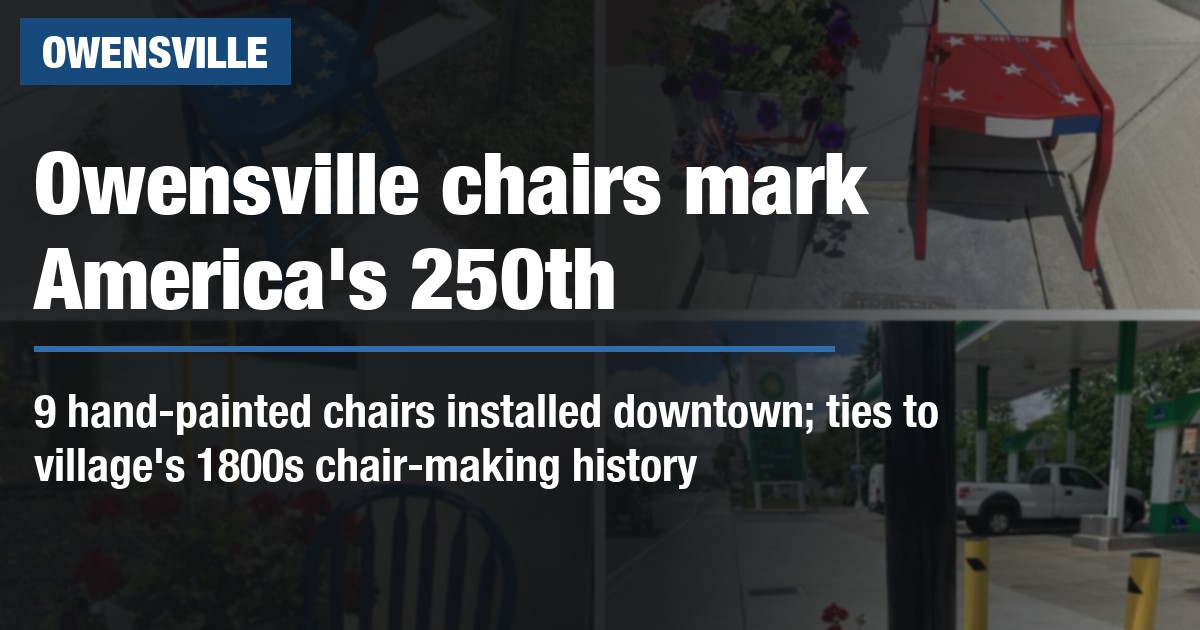
OWENSVILLE, Ohio — Nine hand-painted, patriotic chairs have popped up at intersections and public buildings around Owensville this summer, part of Ohio’s yearlong celebration of the nation’s 250th anniversary and a nod to the village’s own history as a 19th-century furniture-making hub.
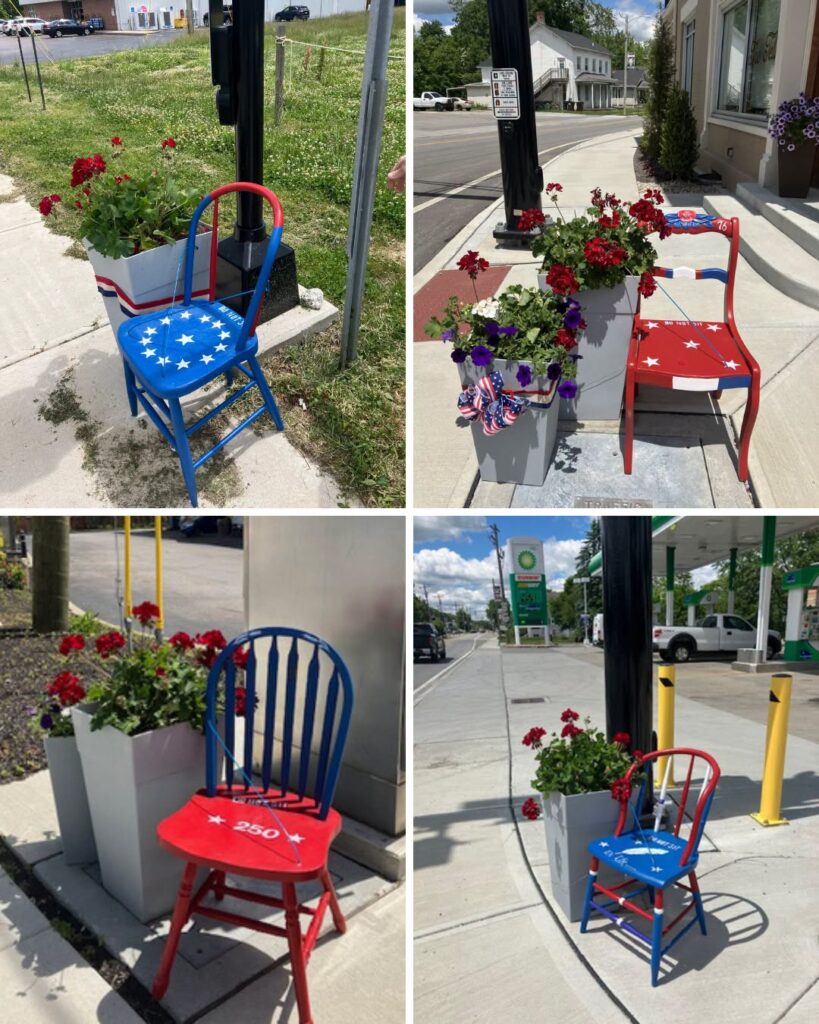
The chairs, painted in red, white and blue with stars and “76” and “250” markings, sit in flower planters outside the Owensville Historical Museum, the village’s Town Hall and at other spots downtown, according to the Clermont County Convention & Visitors Bureau, which promotes the display on its Discover Clermont Facebook page.
The installation is part of America 250-Ohio, the statewide initiative marking the 250th anniversary of the United States’ founding. The Ohio Commission for the U.S. Semiquincentennial has coordinated events across all 88 counties leading up to the anniversary’s culmination on July 4.
The visitors bureau said the chairs also honor Owensville’s history as a chair-manufacturing community in the 1800s, including factories once owned by the Pattison family.
The Pattison name carries particular weight in the village. John M. Pattison was born in Owensville on June 13, 1847, the son of William Pattison, who ran a local country store. After serving in the Union Army during the Civil War and graduating from Ohio Wesleyan University and Cincinnati Law School, Pattison practiced law, served in the Ohio House of Representatives and later the U.S. House, and was elected Ohio’s 43rd governor in 1905. He was inaugurated Jan. 8, 1906, but fell ill that same day and never returned to the office, directing the state’s business from his sickbed until his death on June 18, 1906, at his home in Milford — a roughly five-month tenure that remains the shortest of any elected Ohio governor.
The house that is now the Owensville Historical Museum, at 410 S. Broadway, was once the Pattison family home. Built around 1865, the building was donated to the village in 2003 by longtime resident Agnes Gauche for use by the historical society, which displays photographs, records and artifacts from the village’s past. The museum is open to the public on the second Sunday of most months from 1 to 4 p.m.
The information contained in this story was obtained from the Clermont County Convention & Visitors Bureau’s Discover Clermont Facebook page.